Collecting photographs as art without getting lost in the jargon
Editions and sizes, silver gelatin, chromogenic and pigment prints, signatures and labels, light and framing: a plain guide to living with fine art photography.

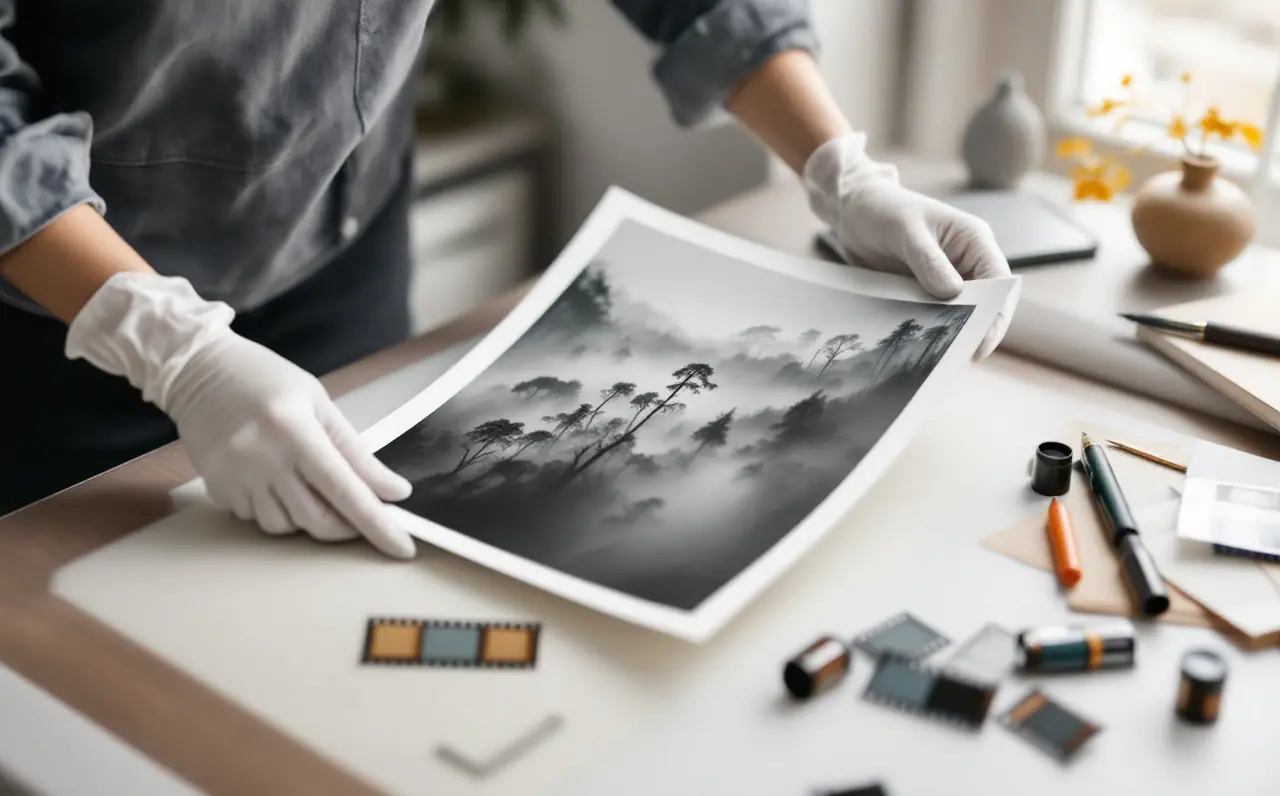
I shoot film on weekends, mostly badly, and I have a shoebox of exhibition invitations going back years. Somewhere between the two I became fascinated by the photograph as an object: not the image on a screen, but the sheet of paper with a particular weight, surface and history. When people tell me they would like to own a photograph but do not know where to start, it is usually the object that confuses them. A painting is obviously one thing. A photograph could, in theory, be printed a thousand times.
The good news is that fine art photography has fairly settled conventions. Once you know how editions, processes and labels work, a photograph becomes as easy to understand as a print, and in some ways easier.
Editions, and why size matters
Most photographers who sell their work as art release it in limited editions. The negative or digital file could make endless prints, so the artist decides in advance how many will exist, numbers them, and stops. An edition might be very small, a handful of prints, or larger for smaller formats. Like printmakers, photographers often keep a few artist's proofs outside the numbered edition.
The detail that trips up new collectors is size. Many photographers edition each size separately. The same image might exist as a small edition of large prints and a larger edition of smaller ones. That is normal and perfectly honest, as long as it is stated. A good label or certificate will tell you the edition for the size you are buying, and ideally also whether the image exists in other sizes and editions.
So "edition of 5" is only half the story. "Edition of 5 at 100 x 150 cm, also available as an edition of 10 at 50 x 75 cm" is the whole of it. If prints are new to you as well, the guide to prints and editions covers the shared vocabulary of numbers, A/Ps and certificates.
Processes: what the print is made of
The process matters for how a photograph looks, how it ages and how you should look after it. These are the three you will meet most often.
Silver gelatin
The classic black and white darkroom print. The paper is coated with light-sensitive silver salts suspended in gelatin; it is exposed under an enlarger and developed in chemical baths. Fibre-based paper, which has a heavier, slightly textured feel, is generally preferred for exhibition prints over plastic-coated paper. A well-processed silver gelatin print is among the most stable photographic objects there is. Its blacks have a depth that is hard to describe until you see one beside an inkjet print.
Chromogenic (C-type)
The standard colour photographic print. Layers of dye form in the paper during processing, whether the print was exposed from a negative in an enlarger or from a digital file. Chromogenic prints have rich, continuous colour and a smooth surface, but their dyes are sensitive to light and can shift or fade over time, especially in strong light. They need more care than a black and white print.
Pigment inkjet
Often called an archival pigment print. Pigment inks are sprayed onto paper, usually a cotton rag or a baryta-coated paper that mimics a darkroom surface. Made carefully on good paper, pigment prints can be very stable. Many photographers now print this way, whether they started with film or a digital camera. There is no shame in the process; the questions are about the paper, the inks and the care taken.
You will also see older or alternative processes, such as platinum and palladium prints, cyanotypes and gelatin dry plate work. Each has its own care needs, so ask.
Signatures and labels
Photographs are often signed differently from paintings. Many photographers sign on the back of the print, in pencil, along with the title, date and edition number. Others sign in the white border on the front, and some use a separate label attached to the backing of the frame. Large prints that are face-mounted or mounted to a rigid backing may carry only a label.
Whatever the form, the information should match the certificate. If a print is signed on the back, you will rarely see the signature again once it is framed, which is exactly why the paperwork matters.
How staged series are shown
Some photographers work less like reporters and more like directors, building scenes over weeks or months with people, props and particular places. The results are usually shown as series, a group of images made around one idea, and that changes how you look at them on the wall.
Tamara Dean is a useful example. She worked as a newspaper photographer before turning to staged, dreamlike images of people in nature, often figures in groups placed in bush, water or gardens. Series such as Instinctual are made as sets of related images, and seeing several together, at the sizes the artist chose, tells you a good deal about why each one looks the way it does. A single frame can feel quiet on its own and much stranger beside its neighbours. The note on Tamara Dean has more on her work.
If you buy a single image from a series, ask how it sits in the set and keep the room sheet. Years later, it is the room sheet that remembers which images hung together. Mine live in the shoebox. The guide to visiting Sydney exhibitions has more on reading room sheets and asking questions without feeling awkward.
A worked example: reading a photograph's label
Imagine this entry on a room sheet:
Pigment print on cotton rag paper, 2018. 80 x 120 cm. Edition of 5 plus 2 A/P. Also exists as an edition of 8 at 40 x 60 cm.
That tells you the process (pigment inkjet), the paper (cotton rag, usually a matte surface), the size of this version, and the full edition picture across both sizes: 7 large prints and 8 small ones, 15 in all, plus whatever proofs exist at the small size, which is worth asking about. Nothing on the label says how it is mounted or framed, so ask that too. A large print might be floated in a frame, mounted to aluminium composite, or face-mounted to acrylic, and each choice affects how you care for it.
Light, handling and condition
Photographs do not like strong light. Colour prints are the most vulnerable, but all photographs and works on paper are better kept away from direct sun and bright spotlights. Choose glazing that filters ultraviolet light, hang on a wall the sun does not reach, and think about rotating a favourite print off the wall now and then. For detailed care advice, the Australian Institute for the Conservation of Cultural Material is the national professional body for conservators and a reliable place to start.
Handle unframed prints by the edges, with clean dry hands or gloves. Fingerprints on a photograph's surface can etch in permanently. Before buying, look at the surface in raking light for scuffs, creases, dents and fingerprints, check the corners, and for older prints look for silvering (a metallic sheen in the dark areas) or yellowing.
For framing, ask for acid-free mat board and backing, and make sure the print does not touch the glass, since a photograph can stick to glazing in humid weather. A window mat does this job for smaller prints; larger floated prints need spacers hidden in the rebate of the frame to hold the glazing clear. Ask the framer to note the process on the back of the frame, too. Whoever opens it in twenty years will thank you, and it may well be you. Hanging height and fixings are the same as for any framed work; hanging art at home goes through the details.
Questions worth asking
Is the edition stated for each size?
It should be. If an image exists at more than one size, ask for every edition and its proofs, not just the one in front of you. This is the single most useful question in photography.
Who made the print, and when?
Some photographers print their own work; others work with a specialist printer. A print made close to the time the photograph was taken, or under the photographer's supervision, is usually described as such. A print made many years later should be described with both dates.
How is it mounted, and can that be undone?
Floating or hinging a print in a frame is reversible. Mounting to a rigid board, and especially face-mounting to acrylic, usually is not. Neither is wrong, but you should know which you have.
Can I see it out of the frame?
If a print is already framed, ask whether you can see it unframed or at least see the back, where the signature, edition number and any printer's stamp usually sit. A seller who has the paperwork in order will rarely mind, and it is the easiest way to check that the label and the object agree.
What should I do if it starts to fade?
Take it off the wall and talk to a conservator before trying anything yourself. Fading cannot be reversed, which is why the light decisions you make on the first day matter most.
A photograph you love will live on your wall for decades. Ten minutes of questions at the start is a fair price for knowing exactly what you have.

Mei-Ling Stroud
Mei-Ling Stroud covers gallery-going and photography: openings, prizes, room sheets and the way a show is hung. She lives in Sydney, shoots film on weekends and keeps a shoebox of exhibition invitations going back years.
In the same room
Prints and editions explained, from etchings to inkjet
What makes a print original, how etchings, lithographs and screenprints differ, what 12/30 and A/P mean, and what a certificate for a print should say.
Buying your first original artwork, step by step
A calm, step-by-step guide to buying a first original work: setting a budget, where to look, what to ask, and the paperwork, payment and delivery that follow.