Essay
John Olsen (1928 to 2023): how to look at his landscapes
John Olsen spent seven decades drawing the country from the inside: Hill End, the harbour, Lake Eyre and its frogs. His life, and how to stand before his work.

| Born | 21 January 1928, Newcastle, New South Wales |
|---|---|
| Died | 11 April 2023, near Bowral, New South Wales |
| Studied | Dattilo Rubbo Art School, Julian Ashton Art School, East Sydney Technical College |
| Major commission | Salute to Five Bells, Sydney Opera House, 1971 to 1973 |
| Prizes | Wynne Prize 1969 and 1985, Sulman Prize 1989, Archibald Prize 2005 |
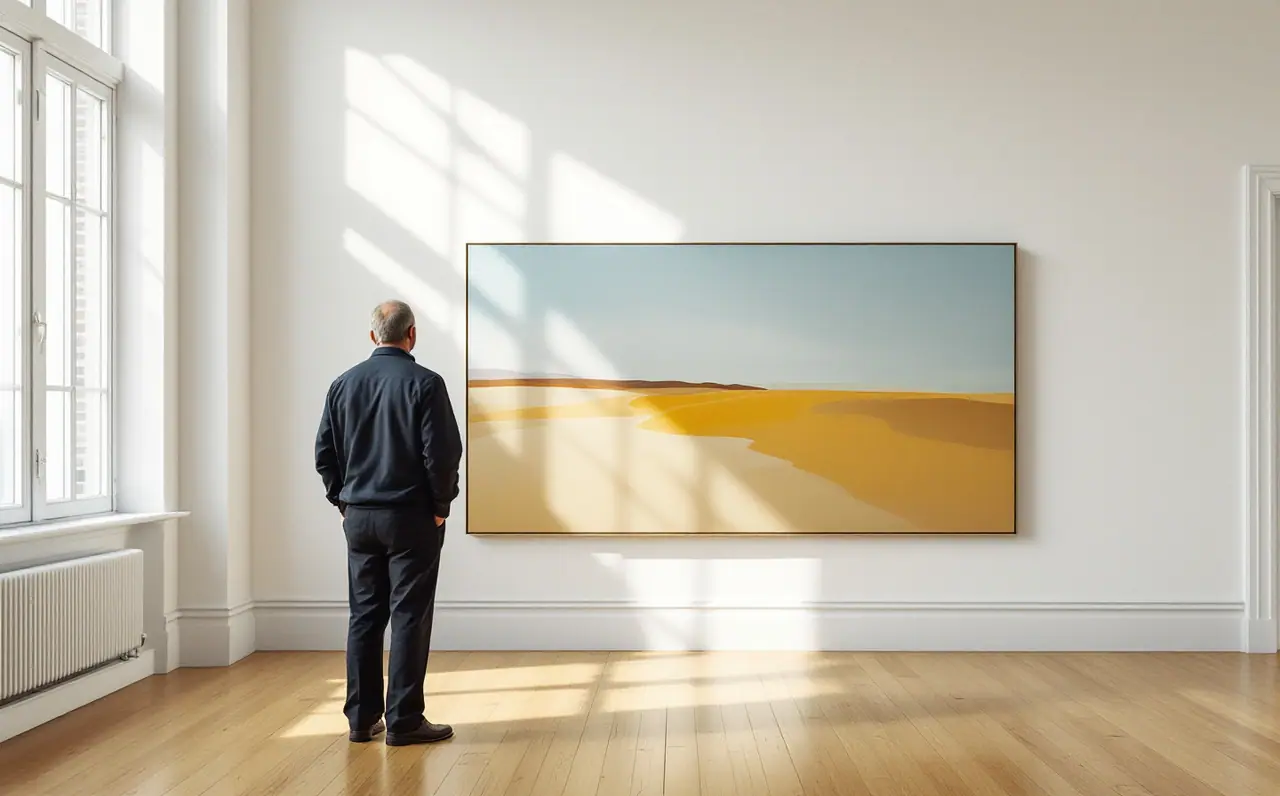
The first John Olsen I remember properly was a big yellow painting in a state gallery, hung where the afternoon light came across it. From the doorway it looked like nothing much: a warm field with a scribble running through it. Up close, the scribble turned into a creek, a dog, a fence, a man walking, a bird lifting off, all of them made with the same quick, bent line. I spent twenty minutes in front of it and came away feeling I had been somewhere rather than looked at something. That is the effect Olsen worked for across a career of more than seventy years, and it is worth knowing a little about the man before you go and stand in front of one of his landscapes.
A Newcastle boy in Bondi
John Olsen was born in Newcastle, New South Wales, on 21 January 1928. His family moved to Sydney when he was about seven and settled at Bondi. He left school young and earned money drawing cartoons and illustrations for Sydney publications, a trade that shows in the speed and wit of his later line.
His formal art training began at the Dattilo Rubbo Art School in 1947. He went on to the Julian Ashton Art School, where the painter John Passmore became his most important teacher, and to classes at East Sydney Technical College, where Godfrey Miller was teaching. Through the 1950s he was part of a group of young Sydney painters who had turned away from straightforward depiction. In December 1956 he showed with Passmore, the sculptor Robert Klippel and Eric Smith in a group exhibition called Direction I, which is now remembered as an early sign of a new, more abstract Sydney painting.
Europe, 1957 to 1960
In 1957, with the help of supporters, Olsen went to Europe. He spent a short time in London, then studied printmaking at Stanley William Hayter's workshop, Atelier 17, in Paris, and in Paris he saw the work of Jean Dubuffet and met painters from the former CoBrA group. Spain held him longest. He settled on Majorca, near the village of Deià, and absorbed Mediterranean food, light and habits of living that stayed with him for life.
He came home in February 1960. That year he painted Spanish encounter, which the Art Gallery of New South Wales bought and which the gallery describes as a turning point in Australian art.
Hill End and the You Beaut Country
In 1960 Olsen spent time at Hill End, the old gold-mining town in the central west of New South Wales. Something clicked. After Hill End he began the paintings he called the You Beaut Country, a run of large works through the early 1960s that took the slang of the Australian bush, "you beaut", and made it into a whole attitude to the land. The best known of them carry long titles about travelling into that country, which tells you how he thought of them: as trips through a place, not views of it.
These paintings are where the familiar Olsen arrives. The ground is no longer seen from a single fixed point. It spreads and tilts, often a warm ochre or yellow, and over it a wandering line records creeks, tracks, scrub, animals and people as if you were moving among them. Writers have often said Olsen put the viewer inside the landscape rather than in front of it. His own phrase, in a statement quoted by the Art Gallery of New South Wales, was that at Hill End he "could feel Australia".
The harbour and Salute to Five Bells
In 1963 Olsen settled in an old fisherman's cottage at Watsons Bay and painted Sydney Harbour in the same restless way. Water, light and the creatures of the harbour moved into the work. The Art Gallery of New South Wales holds a 1963 painting called Five bells, and the title points to the commission that would occupy him a decade later.
Through the Sir William Dobell Art Foundation, Olsen was commissioned to paint a mural for the Concert Hall Northern Foyer of the Sydney Opera House. He worked on it from 1971 to 1973, and it was unveiled when the building opened to the public in 1973. The mural, Salute to Five Bells, is more than 20 metres long and takes its subject from Kenneth Slessor's 1939 poem Five Bells, an elegy for a friend, an artist, who drowned in the harbour. The Opera House notes that the work was designed to be seen after dark, and it reads as a blue and purple, nocturnal underwater space full of drifting signs and forms. The Opera House describes it as his biggest challenge. If you go, stand back first, at the far side of the foyer, then walk its length slowly with the harbour behind the glass.
Lake Eyre, the inland and its creatures
Olsen moved often, and each place changed the work. He spent about two years at Clifton Pugh's artists' community at Dunmoochin in Victoria, around 1969 to 1971, where he also made ceramics. In 1971 he joined a film crew making a documentary series about Australian wildlife, and from then on birds, frogs and sea creatures became more and more central to his paintings.
Then came Lake Eyre. In 1973 and 1974 the great salt lake in South Australia was filling with water, a rare event, and Olsen first went there in October 1974. He described the lake as "a bowl of endless sky". The Lake Eyre paintings, drawings and watercolours that followed are among his most open works: pale salt, thin washes of colour, a few birds or a skein of tracks, and a great deal of empty ground. To my eye they make emptiness itself the subject.
Frogs became his signature creature. He painted them crouched, leaping and swimming, often with a comic tenderness, and set them in creeks and billabongs that seem to breathe. Later studios took him to Clarendon in South Australia, Wentworth Falls, Rydal and finally the Southern Highlands near Bowral, and the work kept returning to water, animals and the surge of growth after rain.
The journals and the writing
Olsen drew and wrote constantly, and his journals mix drawings and written notes on the same pages. A selection of his diaries was published in 1997 as Drawn from Life. When the National Gallery of Victoria and the Art Gallery of New South Wales mounted their joint retrospective, John Olsen: The You Beaut Country, it opened at the NGV in Melbourne in September 2016 and travelled to Sydney in 2017, with more than a hundred works including ceramics, woven pieces and many of his studio journals. If you ever get the chance to look at the journals in a case, do it. You see the same line moving from a frog to a fish to a written sentence without changing gear.
Prizes and honours
Olsen won the Wynne Prize for landscape painting in 1969 and 1985 and the Sulman Prize in 1989. In 2005 he won the Archibald Prize with Self portrait Janus faced, a painting in which his face seems to dissolve into the surrounding marks of the land. He was 77, and the Art Gallery of New South Wales records that he became the oldest artist to win the prize. He was made an OBE in 1977 and an Officer of the Order of Australia in 2001.
He died at his home near Bowral on 11 April 2023, aged 95. The Art Gallery of New South Wales collection page gives a good overview of his career and the works it holds.
How to look at an Olsen landscape
Here is a method I use with any large Olsen. It takes about fifteen minutes and needs nothing but patience.
1. Start from across the room (two minutes)
Find the far wall and look at the whole painting at once. Ask what the main colour is and how much of the canvas it covers. In many of the big landscapes a single warm ground, yellow, ochre or a pale salt white, takes most of the surface. Notice where the activity is gathered: a dense knot of lines in one area, thin scatter elsewhere. That distribution is the composition. There is usually no horizon to anchor you, so let your eye settle where the marks are thickest.
2. Work out where you are standing (three minutes)
Now ask the viewpoint question. Are you looking down, as from a hill or a plane, or along the ground, or somehow both at once? Olsen often mixes them. A creek might be drawn as if from above, while a bird beside it is seen side on. This is what people mean by being inside the landscape: the picture is assembled from many moments of moving through a place, and you are asked to occupy all of them.
3. Follow one line (four minutes)
Walk closer, to about arm's length, and pick a single line. Follow it with your eye from where it starts to where it stops. You will find it changes character as it goes: it thickens where the brush was loaded, thins and skips where it ran dry, bends into a creature and straightens into a track. People call his line calligraphic, and the comparison with brush writing helps. Each mark is made in one movement, and you can feel its speed.
4. Read the colour (three minutes)
Look at the gaps between lines. Olsen's grounds are rarely flat. A yellow field might be laid over red, scraped back, washed with thinner paint. The colour sets the temperature and season: the hot gold of a dry summer, the green flush after rain, the cool blue of the harbour at night.
5. Check the edges (three minutes)
Finally, look at the four edges. In many of his landscapes the lines run straight off the canvas, as if the country carries on past the frame. Very little is enclosed or centred. That open edge is part of the meaning: the painting is a section of something bigger, and you are standing somewhere in the middle of it.
Other pieces in the Australian painting room use a similar approach with other painters. The same habits help with other painters on the artist notes page.
Scale matters
Olsen worked at every size, from small etchings and watercolours to the Opera House wall. The smaller works on paper are often the best way into him, because the line is closer and quicker and you can take in the whole sheet at reading distance. The big canvases ask you to move. Try viewing them from three distances: across the room, at the middle distance where the image holds together, and close enough to see brush hairs in the paint.
Where to see his work
John Olsen is well represented in Australian public collections. The Art Gallery of New South Wales holds a large group of works across his career, from paintings to prints and drawings, and the National Gallery of Victoria, the National Gallery of Australia and other public galleries also hold his work. Some regional galleries also hold prints, drawings or paintings by him, so it is worth checking a regional gallery's online collection before a country drive. Salute to Five Bells remains in its foyer at the Sydney Opera House.
Works rotate on and off display, so check a gallery's website or ask at the desk before making a special trip. If you are planning a day of looking in Sydney, the guide to visiting gallery exhibitions in Sydney covers how to pace yourself and combine public collections with smaller shows.
Sources

Lachlan Pryor
Lachlan Pryor writes about Australian landscape painting and the painters who came of age in the 1950s and 1960s. He grew up in the Hunter Valley and lives in Sydney's inner west, a short train ride from the state gallery he visits most weekends.