Caring for a canvas painting at home
Light, humidity, dust, carrying, slack canvas and storage: the everyday care that keeps an oil or acrylic painting on canvas sound, and what to leave alone.

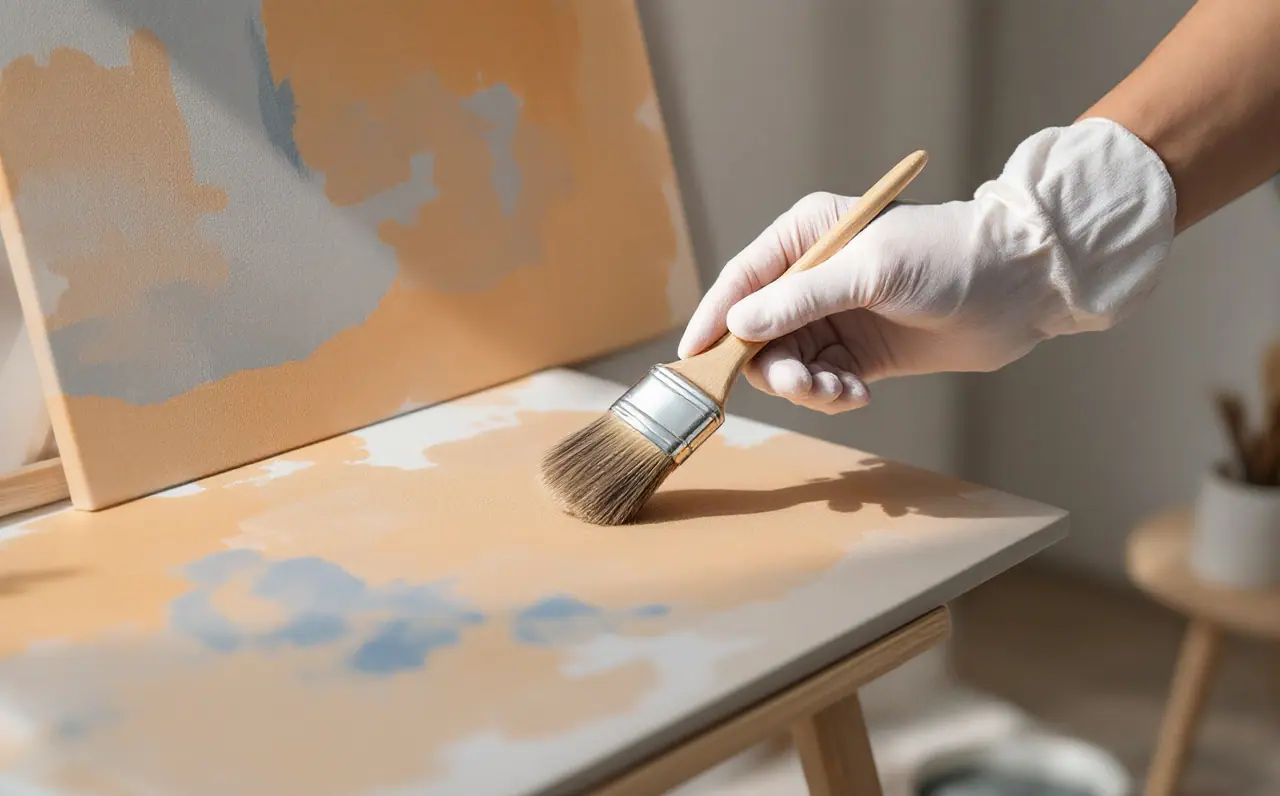
A painting on canvas is tougher than a drawing and more fragile than it looks. It is a thin sheet of fabric stretched over a wooden frame, sized and primed, then covered in layers of paint that are more or less flexible depending on their age and what they are made of. Every one of those layers moves a little when the air around it changes. Most damage to paintings in homes comes from that movement, from light, and from people handling them in a hurry.
The good news is that caring for a canvas mostly means doing less. In my house, which is a 1920s Melbourne weatherboard with original picture rails and a heating system best described as historical, the canvases get a quick look every season, a gentle dusting a couple of times a year, and otherwise they are left in peace. This is what I have learnt about that peace and how to keep it.
Know what you are looking at
Before you care for a painting, turn it around (gently, with two hands, on a padded surface) and look at the back.
- The stretcher is the wooden frame the canvas is pulled over. A good one has bevelled inner edges, so the wood does not press against the back of the canvas and leave a line on the front.
- Keys are the small wooden wedges tucked into the inside corners of many stretchers. They can be tapped in to expand the stretcher and tighten the canvas.
- The tacking margin is the strip of canvas folded around the side of the stretcher and held with staples or tacks.
- The paint surface itself may be oil or acrylic. Oil paint becomes stiffer and more brittle as it ages. Acrylic stays more flexible but is softer, especially when warm, and dust can settle into it more readily.
Write down what you find: the medium if it is noted on a label or certificate, whether there are keys, any labels or inscriptions. Photograph the back while you are there. It will be useful later.
A ten-minute condition check
Do this when a painting first comes home, and then once a year or whenever you move it. You need a torch, a soft cloth and good daylight.
- Stand back and look at the whole surface from a metre or so away. Note anything that looks different from the rest: a dull patch, a shine, a bulge, a ripple.
- Shine the torch across the surface at a low angle, almost parallel to the canvas. This raking light shows up cracks, lifting paint, dents and slack areas better than anything else.
- Look at the corners. Slack canvas often shows first as small diagonal ripples running in from a corner.
- Look at the edges where the canvas wraps the stretcher. Paint here gets rubbed and chipped when paintings are carried.
- Turn the work and check the back: the canvas should be taut and even, with no dark stains, mould, or holes.
- Photograph the front, the back and any area you are unsure about. Date the photos.
As a worked example, say you find a set of fine cracks in a spiral pattern in one corner of a twenty-year-old oil, and a slight ripple along the bottom edge. The spiral cracks are usually a sign of an old knock from behind, possibly before you owned it. If no paint is lifting and nothing has changed since last year, that is something to note and watch, not something to fix. The ripple suggests the canvas has slackened a little. Neither calls for action today. A cupped or flaking area would be different: that is the moment to stop touching it and call a conservator.
Light
Light fades pigments and yellows some varnishes, and the damage adds up and cannot be undone. Paintings on canvas are generally less sensitive than works on paper, but some colours are fugitive, particularly in older paintings and in some modern paints.
Keep canvases out of direct sun, including the patch of sun that moves across a wall in the late afternoon. Watch the room for a whole day before you choose a wall. Ultraviolet filtering film on windows helps in bright rooms, and blinds or curtains drawn in the hottest part of a summer day do more than people expect. Picture lights that clip onto the frame and sit close to the surface can heat it; if you use one, choose a cool LED and keep it on only when you are in the room.
Humidity and temperature
Canvas, wood and glue all respond to moisture. When the air is damp, canvas can sag and wood swells; when it dries out, everything tightens again. Over years, that cycle is what drives cracking and flaking. Many collection-care guides give a comfortable band of roughly 40 to 60 per cent relative humidity, but the more useful idea for a house is stability. A steady room is better than a perfect one that swings.
In practice, that means:
- Do not hang paintings above heaters, fireplaces or air-conditioning vents, or on a wall that gets hot in the sun from outside.
- Avoid bathrooms and laundries, and the wall beside a stove.
- Be wary of outside walls in old, damp houses. A gap of a centimetre or two between the frame and the wall (small cork or felt pads on the lower corners do it) lets air move behind the painting.
- In a holiday house that is shut up for months, consider taking good paintings with you, or at least hanging them on an inside wall.
If you are curious, a cheap digital hygrometer will tell you how much your rooms swing between seasons. Mine taught me that my sunroom is a desert in February and a swamp in July, and nothing I care about hangs there now.
Dust and cleaning
This is where most well-meant damage happens. The rule is simple: no water, no cleaning products, no damp cloths, no bread, no saliva (yes, people do), and no feather dusters, whose quills can catch on raised paint.
What you can do, if the paint is sound and not flaking, is dust it lightly with a soft, wide, clean brush, the kind sold for gilding or for watercolour washes. Hold the painting upright or tilted slightly forward so dust falls away from the surface. Work from top to bottom in gentle strokes, holding the brush so only the tips of the bristles touch. Keep the brush for this job only. If a painting has thick, textured paint, or if anything at all looks loose, leave it alone.
Grime that a soft brush will not lift, yellowed varnish, nicotine and smoke films, water stains and any kind of mark on the paint are jobs for a conservator. Cleaning a painting properly involves testing solvents on tiny areas under magnification, and it is not something to try with a cotton bud from the bathroom cabinet.
Handling and carrying
Paintings get damaged in the few minutes they spend off the wall far more often than in years on it.
- Take off rings and bracelets. Wash and dry your hands, or wear clean cotton or nitrile gloves.
- Carry with two hands, one on each side of the frame or stretcher, never by the top bar or the hanging wire.
- Never press on the front or the back of the canvas. Fingers on the back push out through the front as a dent, and that can crack the paint.
- Clear the route and the landing spot before you lift. Have somewhere padded to put it down, and lean it face to the wall only if the front is protected and the frame takes the weight, not the paint.
- Large works need two people. One person carrying a big canvas in a breeze is a sail.
The site's guide to hanging art at home covers the fixings and hooks once you have the painting safely to the wall.
Keys and slack canvas
When a canvas sags, it is tempting to tap the keys in and tighten it. I leave the keys alone, and I would suggest you do too. Keying out a painting moves the stretcher in a way that pulls on every crack in the paint, and on an old or brittle surface it can cause new cracking or lifting. A small amount of slackness in summer that disappears in winter is normal movement and nothing to chase. Persistent sagging, bulges or distortion are worth showing to a conservator, who can judge whether keying, restretching or something else is right.
Keys that have fallen out sometimes rattle about inside the stretcher bar. Do not shake the painting to find them. Tape them in a labelled envelope to the back of the stretcher, out of contact with the canvas, so they stay with the work.
Storage
If a painting has to go into a cupboard for a while, choose a cool, dark, dry space inside the house, not a garage, shed or roof space. Store canvases upright, never flat with things on top, and stand them on blocks or padding rather than directly on the floor in case of leaks. Pairs of paintings can stand face to face or back to back, separated by sheets of acid-free board, never face to back where a stretcher bar can press into the canvas next to it.
Cover them loosely with clean cotton sheets or acid-free tissue. Avoid bubble wrap against the paint surface, where it can leave its pattern on soft or warm paint, and do not seal paintings in plastic, which traps moisture. Check stored works every few months for mould and insects.
Photographs for insurance and for memory
Insurers vary in what they want, so ask yours, but a basic record is useful for everyone. For each painting, take a straight-on photo of the front in even daylight, a photo of the back showing labels and inscriptions, close-ups of the signature and any existing damage, and a note of the size, medium, date acquired and where it came from. Keep any receipt, certificate or condition report with these. Store the whole lot somewhere other than the house itself, such as a cloud folder or with a family member.
When you buy from an exhibition, it is reasonable to ask for a condition report, especially on an older or larger work. The guide to visiting Sydney exhibitions has more on what to ask in a gallery without feeling awkward.
Questions worth asking
How do I find a conservator?
In Australia, the Australian Institute for the Conservation of Cultural Material keeps a find a conservator directory where you can search for professional members who work on paintings. Ask any conservator for a written estimate and a condition report before work begins.
Should a canvas painting be framed?
It does not have to be. Many contemporary paintings are designed to hang unframed, with painted edges. A simple frame does protect the edges from knocks and gives you something to hold other than the canvas. A tray or float frame is a common choice that leaves the edges visible.
Is it safe to hang a painting in the kitchen?
Away from the stove and kettle, usually yes for a sturdy work you are relaxed about. Grease and steam settle on paint and are hard to remove, so keep anything precious elsewhere.
What about very large or heavily textured paintings?
They need the same care with more patience. Thick paint holds dust in its ridges, so brush along the texture rather than against it, and large canvases are more prone to slackening and to knocks in doorways. Measure the door before you move one. If you are drawn to big paintings of open country, the note on Jo Bertini looks at one painter who has spent years working in remote desert places.

Fenella Garrick
Fenella Garrick writes about framing, hanging and looking after art at home, from mat board to picture rails. She lives in Melbourne in a 1920s house with its original picture rails and firm opinions about hooks.
In the same room
Hanging art at home, one careful step at a time
How high to hang a picture, how to space a group, picture rails versus hooks, fixings for plasterboard, brick and old plaster, and where art should never go.
Framing works on paper so they last
Prints, drawings and watercolours need a different kind of frame from canvases. Mat board, hinges, glazing, spacers and backing, and what to ask your framer.