
A tiled splashback and the pictures that live with it
How a glossy handmade tile changes the light on your walls, which art copes with kitchen and bathroom air, and how to rehang after the tiler leaves.

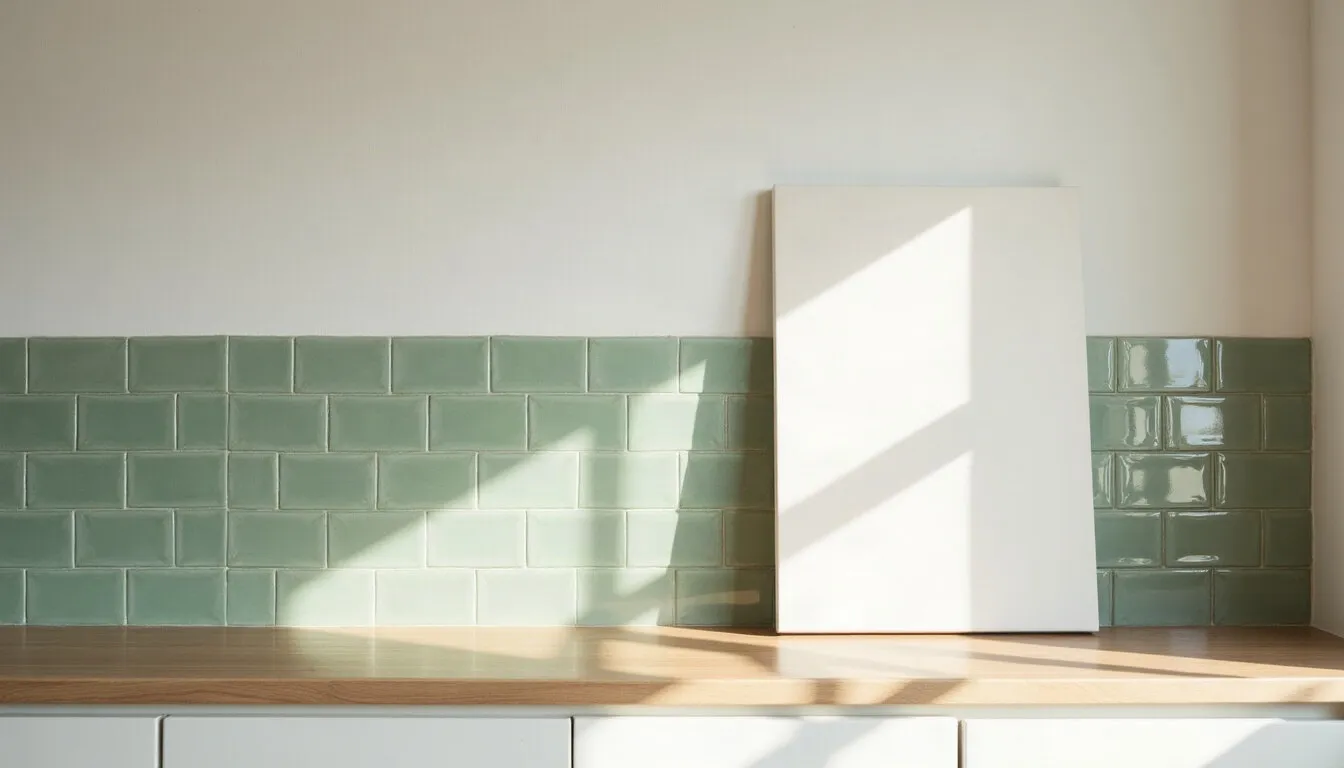
For years a little screenprint of a lemon tree hung on my kitchen wall. Then the old splashback came off, a sample board of glossy green handmade tiles went up beside it, and suddenly the print looked wrong: too pale, and catching a green shimmer on its glass.
When you redo a kitchen or bathroom, tile and pictures share a wall. What should you ask when you're choosing Moroccan zellige for the wall behind the bench? Mostly questions about colour and finish. This piece covers the other half: what a shiny, handmade tile does to the light in a room, which works cope with kitchen and bathroom air, and how to hang them so the tile and the art both get room to breathe.
Look at what the tile does to the light
Zellige is a glazed clay tile, cut and finished by hand, and no two pieces sit quite flat. That unevenness is the whole point. Each tile catches the light at a slightly different angle, so a wall of them shimmers and changes as you walk past. It's lovely, and it also means the wall stops being a quiet background.
Before you hang anything near a new tiled wall, stand in the room at a few times of day and just watch. Morning light through a kitchen window will bounce off a glossy splashback and land somewhere, often on the wall opposite or on the cupboards above. Late afternoon does something different again. If a framed work sits where those reflections land, you'll see the tile in the glass before you see the picture.
Look at the glass from where you actually stand, not from a ladder or the doorway. In a kitchen that usually means the spot by the sink or the stove. If the reflection is bad from there, it's bad.
A few things to notice while you're watching:
- Where the brightest patch of reflected light falls, and when.
- Whether a framed work picks up a colour cast from the tile (green and blue tiles are the usual culprits).
- How busy the tiled wall feels from across the room. Some walls read as calm texture, others as a picture in their own right.
Check what kitchen and bathroom air does to art
Living in Brisbane has taught me to be wary of any wall that gets steamy. Kitchens and bathrooms are the hardest rooms in the house for art, whatever the tile looks like. There's steam from the kettle and the shower, splashes from the sink, and in a kitchen a fine film of cooking grease that settles on everything above the bench.
Works on paper take it worst. Paper drinks moisture from the air and gives it back again, and over time that can lead to cockling (the gentle rippling you see when paper has swelled and dried unevenly) and foxing, the small brown spots that appear on paper kept somewhere damp. A frame doesn't fully protect against that, because air still gets in around the back.
None of this means a tiled room has to stay bare. It just means choosing with care.
| Option | What it does | Suits | Watch for |
|---|---|---|---|
| A sealed painting on board or canvas | Shrugs off a little humidity better than paper | A kitchen wall away from the stove | Grease on the surface; dust gently with a soft brush |
| A print you love but could replace | Lets you enjoy the room without worrying | Bathrooms and steamy laundries | Check the back of the frame for damp now and then |
| A ceramic plate or a small sculpture | Belongs with tile and copes with moisture | Open shelves near a splashback | Secure fixing so it can't be knocked off |
| A precious work on paper | Best kept out of wet rooms entirely | The hallway or a bedroom | Don't let the renovation talk you into moving it in |
A rule I keep: if I'd be upset to see a tide mark on it, it doesn't go in the bathroom. A tide mark is the brownish line left on a mat or paper where moisture has soaked in and dried.
Decide on colour, spacing and where the tile stops
Let one of them lead
A strong tile colour is already a decision about the room. A deep green or blue splashback, or a wall of glossy black, will lead whatever you hang near it. In that case the art can be quieter: a pale drawing in a simple timber frame, a print with a lot of white paper around it. A white, cream or soft beige tile is more forgiving, and it can carry a bolder picture without the two arguing.
If you can't tell which should lead, hold the artwork up next to a sample of the tile in the room's real light. In the kitchen, at the time of day you'll be standing there.
Leave a band of plain wall
The most common thing that goes wrong is a picture crammed into the gap between the top of the tiles and the bottom of an overhead cupboard. Give the art its own stretch of plain wall where you can. A band of painted plaster between the tiles and the frame lets each one read clearly, and it keeps the frame out of the splash zone.
Plan hooks before the tiler arrives
Tiles and picture hooks don't mix well after the fact. Drilling through a glazed tile is a job for a tiler or another tradie with the right bits, not something to try with a borrowed drill on a Sunday. So before the tiles go up, decide where any pictures, shelves or rails will hang, and ask your tiler or builder what makes sense for that wall. If something heavy is going above a tiled area, ask whether the wall needs extra support behind it, and let them decide how.
A worked example: the kitchen splashback and the print above it
Take an ordinary kitchen. A bench runs under a window, the stove sits at one end, and there's a stretch of wall between the window and the overhead cupboards where a framed print has always hung. The old splashback is coming out and a run of glossy handmade tile is going in.
- Before any work starts, take the print down. Wrap it in a clean towel or a blanket and stand it upright in a bedroom, away from the dust. Take a quick photo of the front and the back of the frame, and keep it with any receipt or certificate you have for the work.
- Ask the tiler where the tiles will stop. Will they run right up to the cupboards, or stop at a line with painted wall above? That answer decides whether the print has a home on that wall at all.
- Once the tiles are in and the room is clean, watch the light. Hold the print up in its old spot at breakfast time and again at dinner time. Notice whether the glass is catching reflections from the new tile, and whether the colour of the tile is changing how the print looks.
- Decide. If the reflections are bad, you have a few choices: move the print a little further from the bench, swap to a non-reflective glazing when you next reframe it (worth asking a framer about), or move the print somewhere else and let the tile be the picture in that room.
- Rehang with the bench in mind. Keep the bottom of the frame well clear of where splashes reach, and away from the stove. Wipe the glass with a dry cloth more often than you would in a living room, because cooking grease builds up faster than you'd think.
In my own kitchen the lemon tree print moved one wall over, to a spot where the morning light falls on it directly instead of bouncing off the tiles first. It looks better there than it ever did.
Questions worth asking
Can I hang a picture straight onto a tiled wall?
You can, but it usually means drilling through tile, and that's best left to a tiler or another tradie who has done it many times. It's simpler to plan hanging points before the tiles go on, or to keep pictures on the painted wall above the tiled area.
Will a glossy tile fade my art?
The tile itself doesn't fade anything. Sunlight does, and a shiny wall can bounce more of it around the room. If a work on paper is sitting in a bright patch of reflected light, move it, the same way you would if it were in direct sun.
What's the safest art for a bathroom?
Something you love that you could replace without heartbreak: a print, a poster, a sealed painting or a ceramic piece. Keep originals on paper, family photographs and anything with sentimental paperwork attached in drier rooms.
Step back
This week, stand at your kitchen bench at breakfast and look at the nearest framed picture. If you see the room reflected in the glass more clearly than the work behind it, that picture wants a different wall, and a new splashback is a good excuse to move it.
Wall label
- Subject: hanging art beside a handmade tiled wall
- Medium: glazed tile, framed prints, kitchen and bathroom air
- Hang: before and after a splashback or bathroom renovation
- Note: watch how the tile throws the light before you put a picture back.

Jasper Quayle
Jasper Quayle writes for people buying their first original work: budgets, editions, certificates and the questions worth asking before paying. He lives in Brisbane, where his hallway is mostly prints and picture hooks.
In the same room
Before the new floors go down, take the pictures down
What to ask before new timber floors go in, how to clear and store your art, and how to rehang it once the work is done.
A new bathroom and the pictures that live with it
How to plan a place for art while a bathroom is being redesigned: light, steam, glazing and what to ask for before the walls close.
Regional galleries worth the drive
Why Australia's regional public galleries reward a road trip, seven well-established ones to plan around, and how to fit a gallery into a weekend away.