Where to start with abstract painting if you don't get it
A plain approach to abstract painting for doubters: scale, surface, colour, rhythm, edges and the title as a clue, plus Australian painters and an exercise.

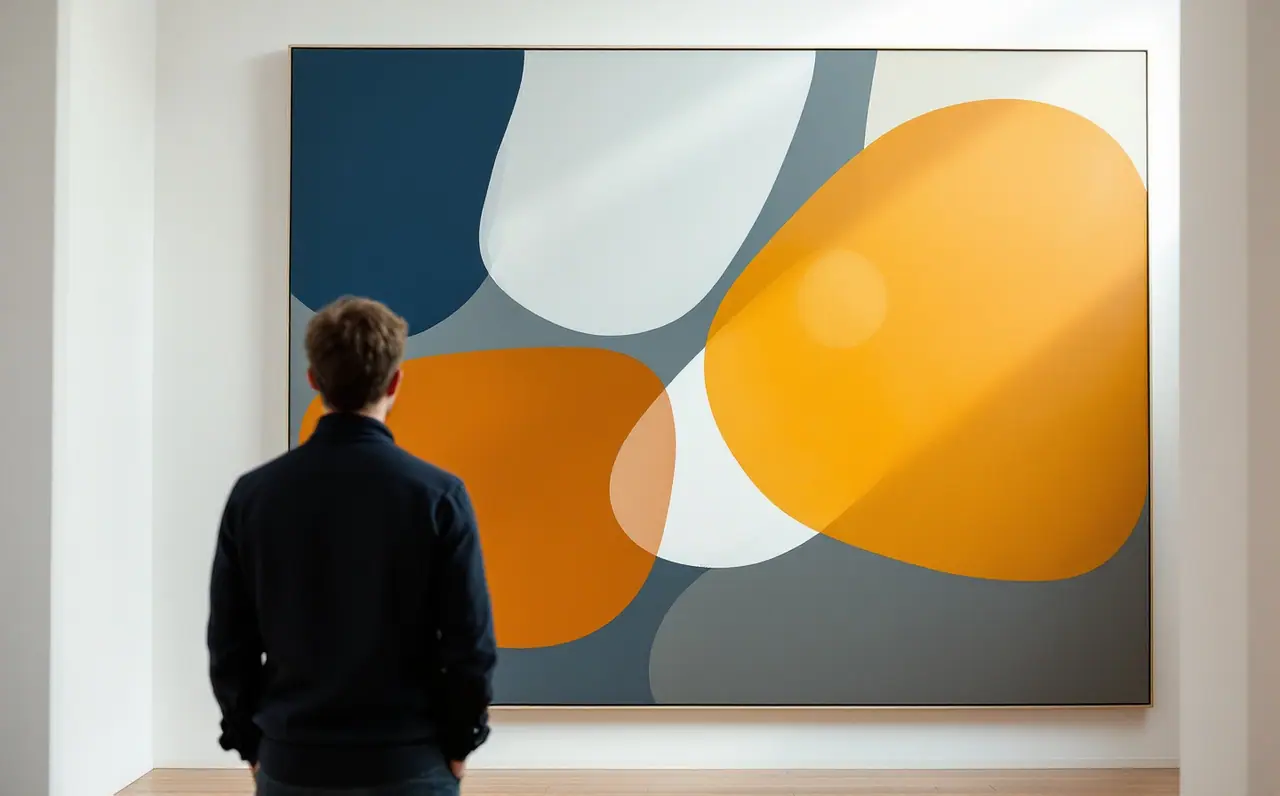
I came to abstract painting late and a bit grudgingly. I grew up looking at landscapes, paddocks and river flats and the paintings people made of them, and for a long time a canvas with no horizon, no tree and no figure felt like a door with no handle. I would walk through the twentieth century rooms of the state gallery on a Saturday and give the big abstract canvases the polite nod you give a neighbour whose name you have forgotten.
What changed was not a revelation. It was a handful of questions I started asking in front of those paintings, the same ones I already asked of landscapes without knowing it. If abstract painting leaves you cold, or makes you suspect you are being had, these are the places I would start.
Stop asking what it is of
The first question most of us bring to a painting is "what is it?" With a landscape the answer comes fast: a hill, a gum, a dry creek. The trouble is that once we have the answer, we often stop looking. Abstract painting takes that question away, and the first feeling is loss.
Try replacing it with a different question: "what is happening here?" Something is always happening. A colour is pushing against another colour. A shape is heavier on one side. A line starts thick and ends thin. The painting is an event on a surface, and your job is to notice the event, not to name an object.
That shift sounds abstract itself, so the rest of this piece breaks it into things you can actually look for.
Scale: where you stand matters
Abstract paintings are often large, and that is not vanity. Many painters wanted a canvas big enough to fill your field of view, so that you are inside the colour rather than looking at it like a postcard. Others work small and want you up close, almost nose to the surface.
Before anything else, find the right distance. Stand back until the whole painting fits comfortably in your view. Then walk slowly towards it until the edges disappear out of the corners of your eyes. Somewhere in that walk there is usually a point where the painting starts to work on you. Some painters wanted their work hung fairly low and seen from close by. If you are reading it from the far wall, you may be missing it.
Surface: how was this made?
Abstract paintings are records of making. With no subject to distract you, the paint itself becomes the subject. Get close and ask simple questions:
- Is the paint thick or thin? Built up in ridges, or stained into the canvas so that the weave shows through?
- Was it brushed, poured, scraped, dripped, rolled?
- Can you see where the painter changed their mind, a colour painted over another with the old one showing at the edge?
- Is the surface matte or glossy, and does it change across the canvas?
I find this the easiest way in, because it is the same curiosity you might bring to a well-made chair or a dry stone wall. You are reading the decisions of a hand.
Colour relationships: one colour is never alone
A red on its own is just red. Put it next to a green and both colours change. Put a thin band of yellow between them and the whole painting shifts again. Many abstract painters spent their lives on these relationships, and once you start noticing them they become absorbing.
Pick two colours that touch and look only at the border between them. Does one seem to sit in front of the other? Does the edge vibrate? Then look away at a white wall for a few seconds and back again. Colours that seemed calm can turn restless, and the reverse.
Rhythm: how your eye moves
Every painting moves your eye. In a landscape the road or the river does it for you. In an abstract painting it is done by repetition, by intervals, by the size and spacing of shapes and marks. Some paintings feel like a slow walk, some like a drum.
Let your eye travel and notice the path. Where does it enter? Where does it rest? Where does it get stuck? A useful trick is to trace the movement in the air with one finger, at a respectful distance. You will be surprised how clearly a painting directs you once you pay attention to it.
Edges: where the painting ends
Look at the four sides of the canvas. Does the painting stop short of the edge, leaving a margin? Do the shapes run off the canvas as if the painting continues beyond the frame? Are the edges of shapes inside the picture crisp, as if cut with tape, or soft and feathered?
Edges tell you a lot about temperament. Hard, clean edges suggest order and measurement. Soft, scrubbed edges suggest speed, doubt or weather. Neither is better, but knowing which you are looking at gives you a vocabulary.
The title as a clue
Abstract painters often give titles that point somewhere: a place, a season, a piece of music, a mood. Others refuse with Untitled or a number, which is a signal too, a request to look at what is there and nothing else.
Read the title after you have spent some time with the painting, then look again. A title such as "Summer, the coast" does not turn the painting into a beach, but it might make you notice that the blue sits low and the warm colours above it, like sea and sky. The title is a hint, not an answer key. If it adds nothing for you, let it go.
Some Australian painters to look for
Abstraction has a longer history in this country than many people assume. Ralph Balson is credited by the Art Gallery of New South Wales with holding the first solo exhibition of purely abstract work in Australia, in Sydney in 1941. It was not much loved at the time. Those paintings were built from flat, overlapping planes of colour, closer to geometry than to gesture, and they are a good place to practise looking at colour relationships and edges.
At the other end of the temperament scale, Tony Tuckson spent more than twenty years at the Art Gallery of New South Wales, much of it as deputy director, while painting large, fast, gestural abstract works largely out of public view. He held his first solo exhibition only in 1970, a few years before his death. In front of a painting like his, the questions about surface and rhythm do most of the work: you can follow the arm that made each sweep.
Much Australian painting sits on the border between landscape and abstraction, and this is where I found my own way across. The aerial views and flattened, mapped land of the mid-century painters, which I wrote about in reading an Australian landscape painting, are halfway there already. John Olsen's sprawling landscapes, which are made from line, scattered marks and washes of colour rather than a fixed view, reward exactly the same questions. The John Olsen essay is a good place to see how a painter can stay faithful to a place while leaving most of its familiar features out.
One caution. Many paintings by Aboriginal artists, particularly from the desert communities, can look abstract to an outside eye: dots, concentric circles, lines and fields of colour. They are usually something quite different, paintings of Country, ancestral stories and knowledge, made within cultural rules about what can be shown. Look at them with the same attention to surface, colour and rhythm, but read the label and the wall text, and do not file them under abstraction just because you cannot see a horizon.
A fifteen-minute exercise
Next time you are in a public gallery, choose one abstract painting you have no particular feeling about. Not one you love, not one you hate. Then work through this:
- Two minutes finding the right distance, walking slowly in from the far side of the room.
- Three minutes on surface, close up, as described above.
- Three minutes on colour: choose one border between two colours and stay with it.
- Three minutes on rhythm: trace the path your eye takes, three times.
- Two minutes on the edges of the canvas and the edges of shapes.
- Two minutes reading the label and title, then one last look.
If you want a longer version of the same discipline for any kind of painting, how to look at a painting slowly sets out a fuller method.
At the end, you do not have to like the painting. That was never the point. Ask yourself whether it is more interesting than it was fifteen minutes earlier. In my experience the answer is nearly always yes, and that small yes is how a person who "doesn't get" abstract painting becomes someone who looks forward to the room.
A note on not liking things
There is an idea that if you do not respond to abstract painting you are missing something, and that is half true. You may be missing it now. You may also simply not care for a particular painter, the way you might not care for a particular novelist. Both are allowed. The difference between dismissing a painting and disliking it is about fifteen minutes of honest attention. Give the painting that much, and then trust your own view.
The jacarandas are out across Sydney in late spring and the light in the galleries is long and clear in the afternoons. It is a good season to pick one painting you have been walking past and stand in front of it for a while.

Lachlan Pryor
Lachlan Pryor writes about Australian landscape painting and the painters who came of age in the 1950s and 1960s. He grew up in the Hunter Valley and lives in Sydney's inner west, a short train ride from the state gallery he visits most weekends.
In the same room
Reading a wall label, line by line
What each line of a museum wall label means, from life dates and medium to height before width and the accession number, and how to read it after you look.
Reading an Australian landscape painting
How Australian painters have handled light, distance and the horizon, from Heidelberg plein air to the aerial view, and how to read the marks on a canvas.
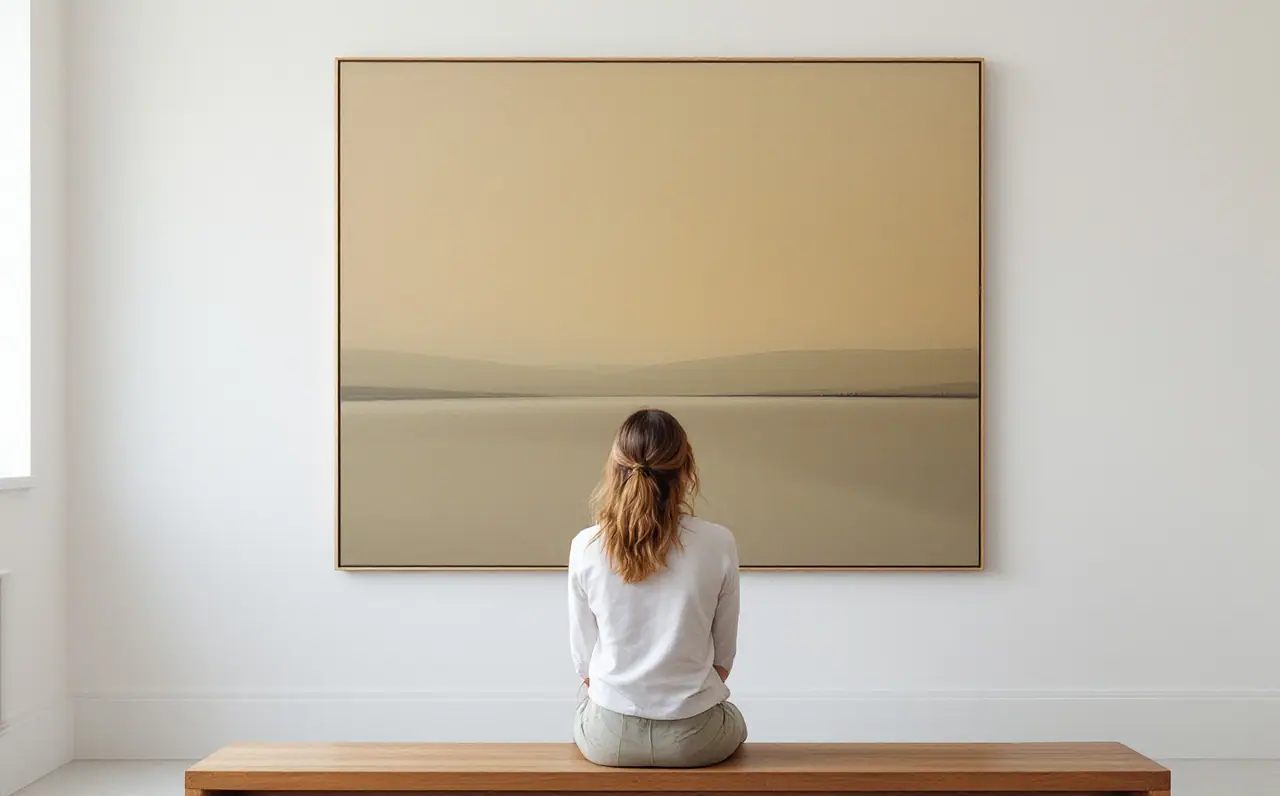
How to look at a painting slowly
A simple, unhurried method for spending ten to twenty minutes with one painting, from first impressions to the label, with a worked example to try.