How to look at a painting slowly
A simple, unhurried method for spending ten to twenty minutes with one painting, from first impressions to the label, with a worked example to try.

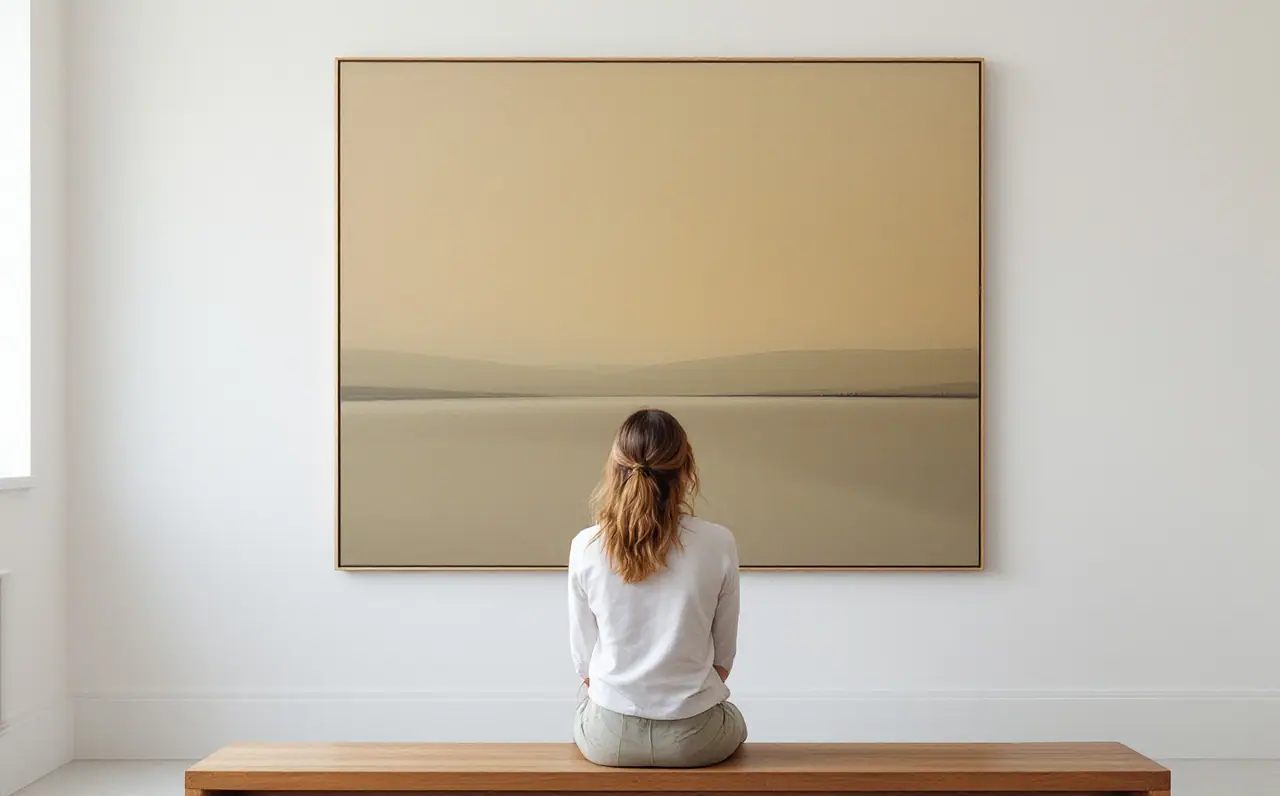
Most of us walk past paintings at the speed of a supermarket aisle. Studies of museum visitors have long suggested that people spend only seconds in front of each work, and anyone who has watched a crowd move through a big exhibition knows the pattern without needing the figures: glance, read the label, take a photo, move on. There is nothing shameful in this. Galleries are large, feet get tired, and there is always another room. But a painting is made slowly, often over weeks, and it tends to give back roughly what you put in. Ten minutes with one picture will usually teach you more than an hour spent grazing.
What follows is the method I use when I want to look properly. It is not a test and there are no right answers. It is a sequence of small prompts that keep your attention on the canvas long enough for it to start doing its work.
Before you start
Pick one painting. Only one. It does not have to be famous or even one you like; something that puzzles you is often better than something that pleases you. Find a spot where you can stand or sit without blocking anyone, ideally at a distance of two or three metres. If the gallery has a bench, take it. Put your phone away, or at least turn it face down in your pocket. You will be tempted to read the label first. Don't. We will get to it at the end.
It helps to set a rough time. Ten minutes is a good start; twenty is a luxury. I glance at my watch when I begin, because otherwise I tend to think I have been standing there far longer than I have.
The method, in six stages
1. First impressions (one to two minutes)
Simply notice what you notice. What did your eye land on first? What is the overall mood: calm, crowded, hot, wet, sombre, funny? Is it mostly light or mostly dark? Say a few words to yourself, even if they are vague ("dusty", "too much going on", "lonely"). These first reactions are worth keeping, because by the end you will often find that the painting has quietly explained them to you.
2. The edges (one to two minutes)
Now look away from the centre and travel slowly around the four edges. Painters think hard about where a picture stops. Does anything get cut off: a tree, a figure, a road? Does the paint run right to the edge, or is there a margin? Is the canvas edge itself painted? The edges tell you what the painter chose to leave out, and that is often as telling as what they kept in.
3. The surface (two to three minutes)
Step closer, as close as the gallery allows (usually there is a line on the floor or a polite guard to tell you). Look at the paint as stuff. Is it thin and stained into the canvas, or thick enough to cast tiny shadows? Can you see the direction of the brush? Are there scrapes, drips, places where the paint has been wiped back? Is the surface glossy or matt? Some areas may have been worked and reworked; others may look as though they were done in one quick pass.
This is the stage most people skip, and it is where a painting stops being a picture of something and becomes a made object with a history. Every mark is a decision someone took with their hand.
4. Colour (two minutes)
Step back again. Try to name the main colours as precisely as you can: not "blue" but "a cold, chalky blue, like a winter sky at four o'clock". Which colour is there most? Which is rarest? Often a painter will put one small patch of a strong colour somewhere to make everything around it sing. Can you find it? Notice, too, whether the colours sit side by side in clean patches or are mixed and muddied into each other.
5. Composition (two to three minutes)
Here you are looking at the architecture. Where are the big shapes? Is there a strong horizontal, vertical or diagonal? Where is the horizon, if there is one, and how high or low does it sit? How does your eye move around the picture: is it led along a path, pushed back into depth, or held flat against the surface? Try half-closing your eyes so the details blur. The big masses of light and dark will jump out, and you will see the bones of the picture.
6. The label, last (one to two minutes)
Only now read the wall label or room sheet. Look at the title, the date, the medium and the size. Then go back to the painting with that information and see what changes. A title can turn an abstract-looking picture into a place. A date can tell you what the painter was reacting against. The medium might explain the surface you noticed in stage three. Sometimes the label adds almost nothing, and that is fine too. The point is that you have already formed your own view, so the label becomes a conversation partner rather than an instruction.
A worked example: an imagined landscape
To make this concrete, here is the method applied to a painting that does not exist, but might hang in any state gallery's Australian rooms. Imagine a canvas about 120 centimetres wide and 90 high.
First impressions: hot and dry. Mostly pale. A feeling of emptiness, with something slightly unsettling about it.
The edges: at the left, a single dead tree is sliced in half by the frame, so you only see one bare branch reaching in. Along the bottom edge, the paint thins out and you can see the weave of the canvas showing through. The top edge is a flat, even band of very pale blue.
The surface: up close, the ground is built from short, stiff strokes laid in different directions, like a stubble field. In the middle distance there is a dry, scratched passage where the painter seems to have dragged the back of a brush through wet paint. The sky, by contrast, is smooth and thin, almost like a wash.
Colour: the dominant colour is a pinkish ochre, the colour of dust on a car. There is a band of grey-green that might be scrub. The rarest colour is a tiny, sharp red, a fleck no bigger than a thumbnail near the horizon. Once you find it, your eye keeps going back.
Composition: the horizon sits very high, so almost three quarters of the canvas is ground. There is no road or path; the land simply tilts up towards you. The half tree at left acts like a door frame, and the red fleck is the only point of arrival. The effect is that you are standing in the land rather than looking across at it from a safe distance.
The label: say it reads "Dry season, Wilcannia track, 1965, oil on canvas". Suddenly the high horizon makes sense as an inland place where the ground matters more than the sky, and the red fleck might be a vehicle, a building, a fire. The date places it in a decade when Australian painters were rethinking how to paint the country from the inside. You might now want to look at how John Olsen tackled the same problem; our essay on how to look at John Olsen's landscapes follows his tilted, wandering viewpoints.
Notice how much of that came from you, before the label said a word.
Why slow looking matters
There is a growing body of writing on "slow looking", and many museums now run slow-looking sessions where a small group spends an hour on a handful of works. You do not need a program to try it. What slow looking offers is fairly simple. It gives your attention something to hold, which is rare enough in a day full of screens. It turns you from a consumer of images into an active reader of them. And it builds a kind of visual memory: after a few sessions you will start noticing edges, surfaces and colour notes in paintings you only glance at, because your eye has learned the habit.
It also changes your relationship with the works you choose to live with. If you ever buy an original painting or print, you will be looking at it for years. Practising on works in public collections is a free education in what you respond to.
A few habits that help
- Go alone sometimes. Conversation is lovely, but it pulls your attention towards words.
- Visit at quiet times. Weekday mornings and the last hour before closing are often calmest.
- Sketch. You do not need to draw well. A rough box with the horizon line and the big shapes marked will show you the composition faster than any description.
- Keep notes. A small notebook with the date, the title and three words per stage builds up into something you will enjoy rereading.
- Return. Go back to the same painting on a different day, in different light, in a different mood. It will not be quite the same picture.
Try it on something living
The same six stages work in any space: a public gallery, a regional museum, a commercial show, a friend's hallway. Contemporary painters are especially rewarding to practise on, because you can often find out more about how they work. The desert paintings of Jo Bertini, for instance, reward attention to surface and light, and our note on Jo Bertini is a good place to begin before you see her work in person.
If you would like more ideas along these lines, the Looking closely room collects our writing on brushwork, colour and composition. Choose one painting, give it ten minutes, and keep your eyes off the label until the end.

Ottilie Ellwood
Ottilie Ellwood writes about looking slowly, art history and the books worth keeping on the shelf. She lives in Hobart and reads exhibition catalogues the way other people read novels.
In the same room
Reading an Australian landscape painting
How Australian painters have handled light, distance and the horizon, from Heidelberg plein air to the aerial view, and how to read the marks on a canvas.