What a room sheet tells you, and how to read it on your feet
The room sheet at a commercial gallery show explained: numbers, titles, media, sizes, prices, dots and the essay, and a two-lap way to read it in the room.

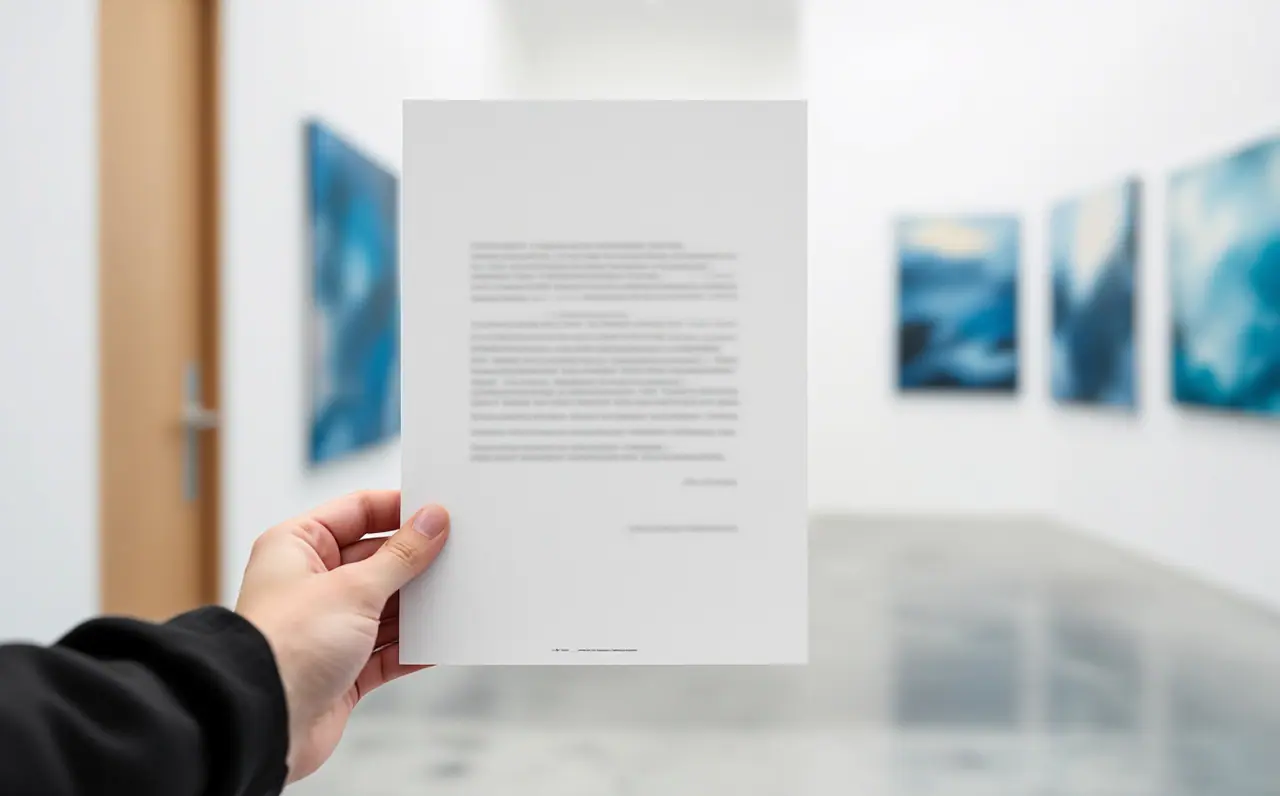
Walk into almost any commercial gallery during a show and somewhere near the door there will be a stack of paper. Sometimes it sits on the desk, sometimes on a plinth or in a clear holder screwed to the wall, and sometimes it is a clipboard you are expected to ask for. It goes by different names: room sheet, price list, catalogue list, floor sheet. Increasingly there is a QR code instead, or as well, which opens the same document on your phone.
I have a habit of taking one home from every show I see, and they live in the shoebox with the opening invitations. Over the years I have learned that this single sheet of paper is one of the most useful things in the building. It tells you what is on the walls, what each work is made of, how big it is, often what it costs and whether anyone has already bought it. It is also the one document most visitors fold in half without reading.
Here is what each part of a typical sheet means, and a way to use it while you walk the room.
Why commercial galleries use a sheet instead of labels
Public galleries put a label next to every work. Commercial galleries mostly do not. The walls are kept clear so the paintings can be seen without clutter, and the information moves to paper. Instead of a label, you will find a small number in pencil or vinyl near each work, or nothing at all, in which case the sheet will include a little floor plan or list the works in hanging order.
That order usually runs from the entrance around the room, often clockwise, but not always. If the numbers jump around, look for the plan. If there is no plan and no numbers, ask. Nobody at the desk will think less of you.
The parts of a room sheet
The table below covers the elements you will see on most sheets, what they mean and what to do with them.
| On the sheet | What it means | What to do with it |
|---|---|---|
| Number | Matches the small number on the wall, or the hanging order | Use it to find your place; circle numbers you want to come back to |
| Title | The artist's title, sometimes with a series name or number | Read it after you have looked, as a clue, not a caption |
| Year | When the work was made | Most works in a solo show are new; an older date is worth asking about |
| Medium | What it is made of: oil on linen, synthetic polymer paint on canvas, charcoal on paper, archival pigment print | Check it against the surface; it affects framing and care later |
| Dimensions | Height before width, usually in centimetres, sometimes with depth | Picture it on your own wall before you fall in love |
| Edition | For prints and photographs, the edition size, such as "edition of 8 + 2 AP" | Tells you how many exist; ask which numbers are left |
| Price | The asking price, often including GST, or "POA" (price on application) | Note whether it includes framing; ask if unclear |
| Dot | Red usually means sold; other colours or a half dot often mean reserved | Conventions vary between galleries, so ask what each mark means |
| NFS | Not for sale, often a work lent back for the show | Look anyway; it may be the key work in the series |
A few of those deserve a little more explanation.
Titles and series
In a show of new paintings, titles often come in families. You might see Inland, study I, Inland, study II and so on, or one long title repeated with a number. That tells you the artist was working through a single idea. When I see a series on a sheet I try to find the first and last numbers on the wall and look at them side by side. You can sometimes see a painter's confidence grow across eight canvases.
Dimensions and the size surprise
Measurements are height first, then width. A painting listed as 150 x 120 cm is taller than it is wide. I find dimensions most useful at home, a day or two later, when I take out a tape measure and hold it against the wall where I imagined the work going. Paintings always look smaller in a large white room with a high ceiling than they will in your living room.
Prices and dots
Many commercial galleries print prices on the sheet. Others keep a separate list at the desk, and some write "POA" against everything and expect you to ask. None of these is a trick. They are different house styles. If a price includes a frame, the sheet will usually say so, and if it does not say, it is a fair question.
The dot is the most famous mark in the commercial gallery world. A red dot on the wall next to a work, and a matching mark on the sheet, means it has been sold. Some galleries use a different colour or half a dot for a work on hold while a buyer decides. Beside a print or photograph you might see several small dots in a row, one for each sold impression from the edition. A sheet covered in red on the first Saturday tells you something about demand, but it says nothing about whether you will like the work, so do not let it hurry you.
If you are new to the way prices, holds and stockrooms work, visiting a commercial gallery explains the system in more detail.
The essay on the back
Many sheets have a short essay, either on the reverse or as a separate folded page. It might be written by the artist, by a curator or critic, or by the gallery itself. A good one is a few hundred words long and gives you something concrete: where the work was made, what the artist was reading or walking through, what changed since the last show.
I read the essay after my first look at the room, never before. Essays are persuasive by design, and if you read one first you will tend to see the paintings it describes and miss the ones it does not. On the way out, with the essay in mind, I take a second look at the two or three works that stayed with me. Sometimes the essay opens a painting up. Sometimes it describes a show I cannot see on the walls at all, which is worth knowing too.
The back page may also carry a short biography or CV: art school, previous solo shows, prizes, public collections. Read it as context. It tells you how long the artist has been working, which can help you understand why the work looks the way it does.
A worked example: two laps with a sheet
Say you walk into a show of 14 paintings by an artist you do not know. The sheet lists them by number, gives oil on linen for most and charcoal on paper for the last three, lists sizes from 30 x 25 cm up to 150 x 180 cm, and has a short essay on the back. There are dots against four of the large works.
On the first lap, put the sheet in your pocket. Walk the room once at an easy pace, without stopping for long. Notice which works pull you closer and which you pass by. You might find you keep returning to number 9, a small canvas, and you hardly look at number 2, the largest painting in the show.
On the second lap, take the sheet out and a pencil if you have one. At each work, find its number and read the line. Number 9 turns out to be 40 x 30 cm, oil on board rather than linen, and older than the rest by a year. That difference in support might explain why it looks denser and flatter than its neighbours. Number 2 has a dot. Interesting, but not a reason to change your mind.
At the end, mark the sheet: a circle for works you want to remember, a question mark for anything you want to ask about. Then sit down, if there is a bench, and read the essay. If it mentions the move from linen to board, you have found the thread of the show yourself, before anyone told you. That is a good feeling, and it is the main reason to read the sheet in this order.
Take the sheet home. Write the date and the gallery's suburb on the top. Months later, when the same artist shows again, you can pull it out and compare.
When there is no paper at all
More galleries now send the list as a PDF to their mailing list in the week before an opening, or post it on their website. This is handy: you can read it on the train, look up sizes and plan your visit. It also means you can see what is on the list before you go. The habit of two laps still works with a phone in your pocket, and a screenshot does the same job as a pencilled circle.
If you are planning a day around several shows, the exhibitions guide has notes on how the Sydney calendar works and how to find out what is on. More on openings, prizes and the way a room is hung lives in the Gallery-going room.
A small kindness to yourself
A room sheet is printed for buyers, but it is just as useful to someone who is only looking. You are allowed to take one. You are allowed to keep it. Nobody expects you to buy anything because you picked up the list on your way in. In the warm late spring evenings, when the openings run late and the rooms are crowded, the sheet is often the quietest way to spend time with a show: a few minutes, a pencil, and the numbers on the wall.

Mei-Ling Stroud
Mei-Ling Stroud covers gallery-going and photography: openings, prizes, room sheets and the way a show is hung. She lives in Sydney, shoots film on weekends and keeps a shoebox of exhibition invitations going back years.
In the same room
Regional galleries worth the drive
Why Australia's regional public galleries reward a road trip, seven well-established ones to plan around, and how to fit a gallery into a weekend away.
Visiting the Archibald Prize and its room full of faces
Where the Archibald came from, what its rules ask of a portrait, how the Wynne, Sulman, Packing Room and People's Choice fit in, and how to look at the walls.

Visiting a commercial gallery for the first time
Commercial galleries are free, quiet and glad to see you. How price lists, red dots and stockrooms work, and how to walk in without feeling like an intruder.